

Best Custom Golf Simulator Enclosure Materials

Table of Contents
Materials That Matter: What Makes a Durable Golf Simulator Enclosure
How to Build Golf Simulator Frame: EMT Conduit vs. Wood vs. Aluminum
EMT Conduit: The Budget-Friendly Rigid Option
Wood Framing: Aesthetic and Stable
Aluminum Construction: Premium Durability
Golf Simulator Impact Screen Material: Fabric Performance Comparison
Multi-Layer Polyester: Industry Standard
Ballistic Nylon: Maximum Durability
Opaque Backing and Light Bleed Control
Golf Simulator Safety Netting and Side Protection
High-Density Side Netting Requirements
Foam Padding and Ball Ricochet Prevention
Tensioning Systems and Hardware: Keeping Everything Flat and Secure
Bungee Cord Tensioning for Screen Flatness
Grommets and Velcro Attachments
Material Durability in High-Impact Environments
Acoustic Dampening Performance
Fire Safety and Flame Retardancy Standards
Long-Term Degradation and Material Lifespan
How to Choose the Right Material for Your Space
Room Dimensions and Ceiling Height
Climate Considerations and Environmental Durability
Budget vs. Performance Trade-Offs
Frequently Asked Questions
Last Updated: September 27, 2026
Materials That Matter: What Makes a Durable Golf Simulator Enclosure
Building a high-performance golf simulator enclosure requires golf simulator enclosure materials that withstand repeated ball strikes, humidity, and daily use. The best golf simulator enclosure materials balance durability, projection quality, and structural integrity.
Material selection determines whether your setup stays flat and accurate for five years or develops wrinkles and light leaks within months. The difference comes down to fabric weave density, frame rigidity, and impact energy absorption.
This guide covers impact screen fabrics, frame construction, safety systems, and tensioning hardware to help you evaluate choices based on space, budget, and performance needs.
How to Build Golf Simulator Frame: EMT Conduit vs. Wood vs. Aluminum
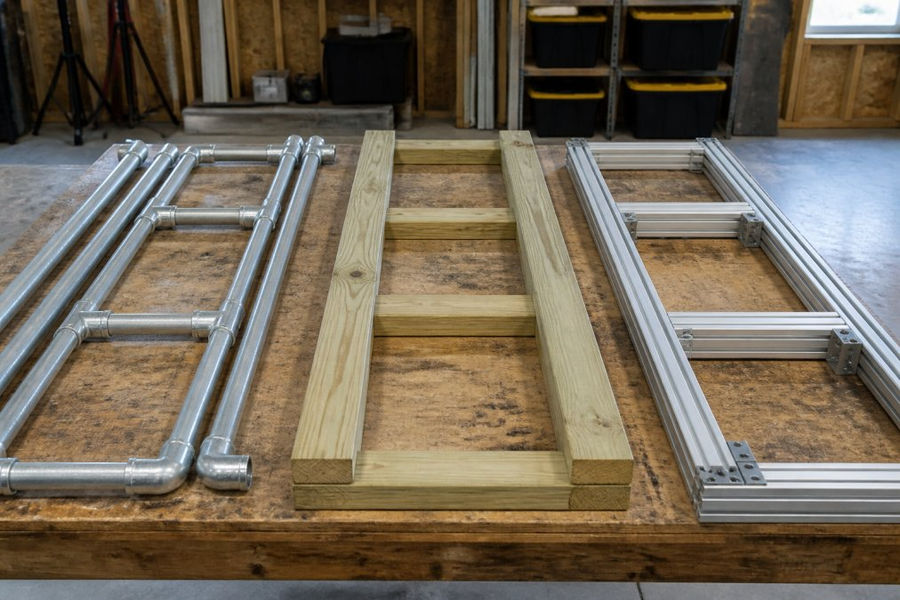
Your frame must stay square, resist deflection under impact, and support fabric, netting, and hardware without flexing. The three most practical options each have distinct trade-offs.
EMT Conduit: The Budget-Friendly Rigid Option
Electrical Metallic Tubing (EMT) is the industry standard for DIY simulator frames. It's affordable, widely available, and engineered for structural rigidity at $15-$25 per 10-foot section.
EMT excels at holding geometry and resists bending under repeated impacts. Cut sections with a hacksaw, then assemble using corner fittings and bolts. Measure twice to account for connector thickness.
Raw metal rusts without protection. Most builders wrap EMT with foam pipe insulation ($5 per section) to protect the frame and reduce noise.
Wood Framing: Aesthetic and Stable
Pressure-treated 2x4s or 2x6s create a finished frame that integrates seamlessly into a home. Wood is easier to work with: cut with a circular saw, attach fabric with staples, and finish with stain or paint.
Wood absorbs vibration better than metal and feels like built-in furniture. It's forgiving: patch holes, sand edges, and adjust mounting points without special tools.
The trade-off is durability in humid environments. Pressure-treated lumber resists decay but requires annual inspection and protective coatings. Over five years, wood frames often develop warps that create screen tension problems.
Aluminum Construction: Premium Durability
Aluminum tubing offers rigidity like EMT plus corrosion resistance. It doesn't rust, is lighter than steel, and needs no additional coating.
Aluminum costs two to three times more than EMT but eliminates the need for foam insulation, rust protection, and ongoing maintenance.
Golf Simulator Impact Screen Material: Fabric Performance Comparison
The screen is the projection surface, ball impact barrier, and acoustic dampening layer. Fabric choice determines image clarity, ball bounce-back, and screen longevity.
The Indoor Golf Shop
Multi-Layer Polyester: Industry Standard
Multi-layer impact-resistant polyester combines a high-density front weave with backing layers that absorb ball energy. Most commercial simulators use it because it balances performance and cost.
Good polyester has tight weave density that minimizes light bleed and maintains sharp projection. Backing layers absorb sound and slow ball velocity.
Polyester degrades with UV exposure and repeated impacts. After three to five years of heavy use, expect tears, fading, or tension loss. Replacement screens cost $300-$800.
Ballistic Nylon: Maximum Durability
Ballistic nylon resists abrasion and puncture far better than polyester. For 100+ balls per week, it extends screen life by 50 percent or more.
Ballistic nylon is heavier, more expensive, and requires stronger tensioning. Wrinkles may become permanent in stiffer nylon.
For most residential setups, ballistic nylon is overkill.
Opaque Backing and Light Bleed Control
Light bleed, visible gaps where light escapes around screen edges, ruins immersion. A quality impact screen includes an opaque backing layer to block light from behind.
Golf Simulator Safety Netting and Side Protection
Golf balls traveling at 100+ mph require safety netting and padding to protect the golfer and enclosure.
High-Density Side Netting Requirements
High-density side netting (1/4-inch mesh or smaller) catches errant shots and extends from floor to one foot above the highest swing point.
Foam Padding and Ball Ricochet Prevention
Foam pipe insulation absorbs ball impact and prevents dangerous ricochets. Foam dampens energy and controls rebound direction.
Tensioning Systems and Hardware: Keeping Everything Flat and Secure
Proper tensioning keeps fabric flat and distributes impact energy evenly, preserving projection quality and ball flight accuracy.
Bungee Cord Tensioning for Screen Flatness
Bungee cords are the standard tensioning solution. A typical 12-by-10-foot screen uses eight to twelve positioned around the perimeter.
Grommets and Velcro Attachments
Grommets are metal eyelets that anchor the screen to the frame. Use solid brass or steel; cheap plastic grommets tear under tension.
Material Durability in High-Impact Environments
Material lifespan depends on impact frequency, environmental exposure, and maintenance.
Acoustic Dampening Performance
A golf ball striking bare metal produces a sharp ping; the same impact on a foam-wrapped frame with fabric backing produces a dull thud.
Fire Safety and Flame Retardancy Standards
Building codes in many jurisdictions require flame-retardant materials in enclosed spaces. Most commercial impact screen fabrics meet NFPA 701 (Standard Methods of Fire Tests for Flame Propagation of Textiles and Films), which tests flammability under specific conditions.
Long-Term Degradation and Material Lifespan
Under typical use (10-15 balls per week), quality materials last five to seven years before noticeable degradation. Heavy use (50+ balls per week) accelerates wear, expect screen replacement every three to four years.
Material | Cost Range | Durability | Best For | Maintenance |
EMT Conduit Frame | $200-$400 | 5-7 years | Budget builds | Annual rust inspection, foam replacement |
Wood Frame | $300-$600 | 3-5 years | Aesthetic priority | Annual sealing, warp monitoring |
Aluminum Frame | $600-$1,200 | 7-10 years | Permanent installations | Minimal; annual inspection |
Multi-Layer Polyester Screen | $300-$600 | 3-5 years | Most setups | Tension adjustment as needed |
Ballistic Nylon Screen | $600-$1,000 | 5-7 years | Heavy use areas | Same as polyester |
High-Density Side Netting | $200-$400 | 4-6 years | All enclosures | Tear inspection, replacement as needed |
Foam Pipe Insulation | $50-$100 | 2-3 years | All frames | Periodic replacement |
Bungee Cord Tensioning | $30-$50 | 3-4 years | All screens | Tension adjustment, cord replacement |
How to Choose the Right Material for Your Space
Selecting the right materials depends on three factors: your room dimensions, environmental conditions, and budget.
Room Dimensions and Ceiling Height
Ceiling height is the primary constraint. Most golfers need nine feet minimum to swing comfortably without hitting the ceiling. If your space is tighter, you'll need to build a more compact frame and accept a shorter hitting area.
Climate Considerations and Environmental Durability
Florida's humidity and temperature swings accelerate material degradation. Pressure-treated wood requires annual sealing. EMT conduit needs foam protection and rust inspection. Polyester screens fade faster in humid environments.
Budget vs. Performance Trade-Offs
Pro Tip Don't cheap out on screen fabric. A $400 quality polyester screen outperforms a $200 budget screen for five years. The difference in projection clarity and ball bounce-back is immediately noticeable.
For most homeowners, a mid-range build using aluminum framing and quality polyester screen ($2,500 to $4,000) offers the best balance. You get durability and low maintenance without premium pricing.
Frequently Asked Questions
What is the best material to use for a golf simulator enclosure?
The best material depends on your priorities. Multi-layer polyester impact screen fabric is the industry standard for the hitting surface because it balances durability, image clarity, and cost. For the frame, EMT conduit offers maximum customization at the lowest cost, while aluminum provides superior durability and aesthetic appeal. Ballistic nylon screens last longer but cost more. Most custom golf simulator enclosure materials combine EMT or aluminum framing with high-density polyester screens and high-density side netting for safety.
How do you prevent bounce-back in a golf simulator enclosure?
Bounce-back happens when the impact screen is too taut or lacks proper absorption. Use bungee cord tensioning systems to create slight give in the screen rather than rigid mounting. Multi-layer polyester fabrics are engineered to absorb impact energy better than single-layer materials. Ensure proper screen tension by adjusting bungees evenly across all edges. High-density side netting also reduces ball ricochet by absorbing energy at the sides. Foam pipe insulation around frame elements prevents secondary bounces off the structural frame itself.
Can I use PVC for golf simulator enclosure?
PVC is not recommended for golf simulator frames. While affordable, PVC lacks the structural rigidity needed to handle repeated ball impacts and frame stress. EMT conduit, aluminum, or wood are superior choices because they maintain frame squareness and stability over time. PVC can flex, warp, or crack under impact loads, compromising screen tension and projection accuracy. Steel corner fittings with EMT or aluminum provide the frame rigidity necessary for professional-grade enclosure performance.
What fabric is best for golf impact screens?
Multi-layer impact-resistant polyester is the most common choice, offering good image clarity, durability, and noise reduction at a mid-range price point. Ballistic nylon provides maximum durability and longevity, making it ideal for high-frequency use, though it costs more. Both should have opaque backing to prevent light bleed and maintain image quality in brighter rooms. The fabric's tensile strength and abrasion resistance determine how long it withstands ball strikes. Custom cut sizes and proper tensioning systems ensure the screen performs optimally.
How do I know if my enclosure materials will handle Florida's climate?
Florida's heat and humidity accelerate material degradation, so prioritize materials with proven longevity. Aluminum frames resist rust better than steel and won't warp like wood in high humidity. Polyester and ballistic nylon screens are moisture-resistant, but ensure your enclosure has proper ventilation to prevent mold growth on backing materials. Foam pipe insulation can degrade faster in humid conditions, so inspect it regularly. Professional installation with proper sealing around edges prevents moisture intrusion.
GET A QUOTE


Comments